|  The Christmas Card Christmas cards originated in England
over 150 years ago. "You cannot reach perfection though you try however hard to
there's always one more friend or so you should have sent a card to," wrote Richard
Armour. Sir Henry Cole knew exactly what Armour was saying.
The founder of the Victoria and Albert Museum in London had so many Christmas greetings to
send that handwriting them was impossible. Yet he wanted to make his friends aware
of the need to help the destitute on that holiday. The Christmas Card Christmas cards originated in England
over 150 years ago. "You cannot reach perfection though you try however hard to
there's always one more friend or so you should have sent a card to," wrote Richard
Armour. Sir Henry Cole knew exactly what Armour was saying.
The founder of the Victoria and Albert Museum in London had so many Christmas greetings to
send that handwriting them was impossible. Yet he wanted to make his friends aware
of the need to help the destitute on that holiday.
The answer. In the year 1843,
Sir Henry commissioned John Calcott Horsley
to paint a card showing the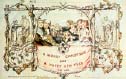 feeding and clothing of the poor. A center panel
displayed a happy family embracing one another, sipping wine and enjoying the festivities.
(So much for good intentions. The card drew criticism because showing a child enjoying a
sip of wine was considered "fostering the moral corruption of children.")
"A Merry Christmas and a Happy New Year to You" was printed on that first
card. Legend says Sir Henry didn't send any cards the following year, but the custom
became popular anyway. feeding and clothing of the poor. A center panel
displayed a happy family embracing one another, sipping wine and enjoying the festivities.
(So much for good intentions. The card drew criticism because showing a child enjoying a
sip of wine was considered "fostering the moral corruption of children.")
"A Merry Christmas and a Happy New Year to You" was printed on that first
card. Legend says Sir Henry didn't send any cards the following year, but the custom
became popular anyway.
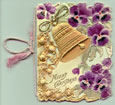
Holiday cards designed by Kate
Greenaway, the Victorian children's writer and illustrator and Frances Brundage and Ellen
H. Clapsaddle, were favorites in the late 1800's and early 1900's. Most were
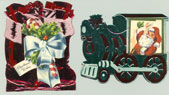
elaborate , decorated with fringe, silk and satin. Some were shaped liked fans and
crescents; others were cut into the shapes of bells, birds, candles and even plum
puddings. Some folded like maps or fitted together as puzzles; other squealed or
squeaked. Pop-up Cards reveled tiny mangers or skaters with flying scarves gliding
around a mirrored pond.
  For more than
30 years, Americans had to import greeting cards from England. In 1875, Louis Prang, a German immigrant to the U.S., opened a lithographic
shop with $250 and published the first line of U.S. Christmas cards. His initial creations
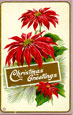
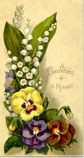
featured flowers and birds, unrelated to the Christmas scene. By 1881, Prang was producing
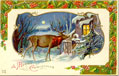
more than five million Christmas cards each year. His Yuletide greetings began to feature
snow scenes, fir trees, glowing fireplaces and children playing with toys. His painstaking
craftsmanship and lithographic printing have made his cards a favorite of collectors
today. Christmas Cards have changed since the days of Sir Henry and Louis
Prang. They now sport comics, jokes and clever verses. But those that picture
timeless and simple settings such as excited children around a Christmas tree, Nativity
scenes, nature scenes and carolers singing in the snow are still in the highest demand
today. For more than
30 years, Americans had to import greeting cards from England. In 1875, Louis Prang, a German immigrant to the U.S., opened a lithographic
shop with $250 and published the first line of U.S. Christmas cards. His initial creations
featured flowers and birds, unrelated to the Christmas scene. By 1881, Prang was producing
more than five million Christmas cards each year. His Yuletide greetings began to feature
snow scenes, fir trees, glowing fireplaces and children playing with toys. His painstaking
craftsmanship and lithographic printing have made his cards a favorite of collectors
today. Christmas Cards have changed since the days of Sir Henry and Louis
Prang. They now sport comics, jokes and clever verses. But those that picture
timeless and simple settings such as excited children around a Christmas tree, Nativity
scenes, nature scenes and carolers singing in the snow are still in the highest demand
today.
- Juddi Morris, Vivian Hotchkiss
And now, our Christmas Gallery. We're sure you will enjoy your journey through some
of our oldest and most unusual cards.
Christmas
Gallery Page One
Click on the
thumbnail images to view cards in their actual size.
|